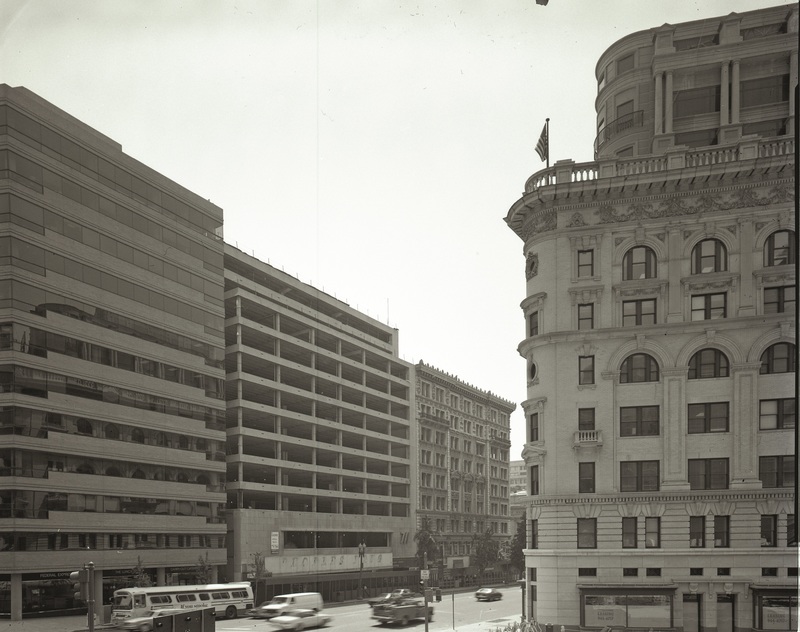
Civil Rights Tour: Protest - Thompson's Restaurant and the Lost Laws: 725 14th Street NW (Site)
Text
In early 1950, Mary Church Terrell and other activists attempted to eat at Thompson’s Restaurant, a downtown cafeteria and one of many restaurants and eateries with a whites-only policy. The group was deliberately testing the validity of Reconstruction-era laws that gave African Americans equal access to restaurants, hotels and other commercial establishments—a test that landed three years later in the Supreme Court. The Court upheld these laws, dealing another blow to Jim Crow practices in the District and nationwide.
The sit-in followed earlier protests waged by Howard University students, notably Ruth Powell and Pauli Murray. In 1944, Murray discovered that local laws adopted in 1872 and 1873 promising African Americans equal access to commercial establishments in the city had mysteriously disappeared off the books. "Elated over these preliminary findings," she wrote, "I went around the law school waving the statute and arguing that the old civil rights legislation was still in force." (Murray, already a seasoned activist, was the only woman and the top student in Howard University's law school class of 1944.)
Soon after these laws were publicized in the 1948 report Segregation in Washington, and after a team of civil rights attorneys presented the DC Commissioners with their findings that the laws were still valid, Mary Church Terrell and other local activists organized the multi-racial Coordinating Committee for the Enforcement of the DC Anti-Discrimination Laws. They chose DC’s newest branch of Thompson’s―part of a Chicago chain with four locations here―for a lunchtime visit on February 28, 1950. When Terrell and the other two African Americans in the group were refused service, they persuaded the city to sue, and the case eventually advanced to the US Supreme Court as District of Columbia v. John R. Thompson Co., Inc. On June 8, 1953, the Court ruled that the "lost laws" were still valid, thus ending the legality of enforced segregation of public accommodations in Washington. The 89-year-old Mary Church Terrell celebrated the victory in this landmark ruling just one year before her death. The building that housed Thompson's Restaurant was razed and replaced with the office building in the 1980s.
Files
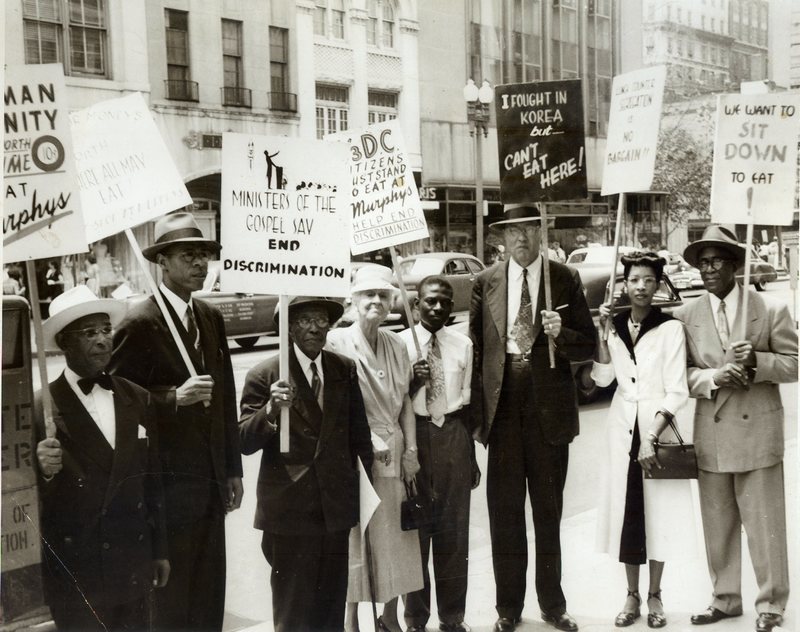
Mary Church Terrell (fourth from left) and others picketed Murphy’s five-and-dime in the early 1950s because its lunch counter did not serve African Americans.
Source: Courtesy of the Moorland-Spingarn Research Center, Howard University Archives, Howard University, Washington DC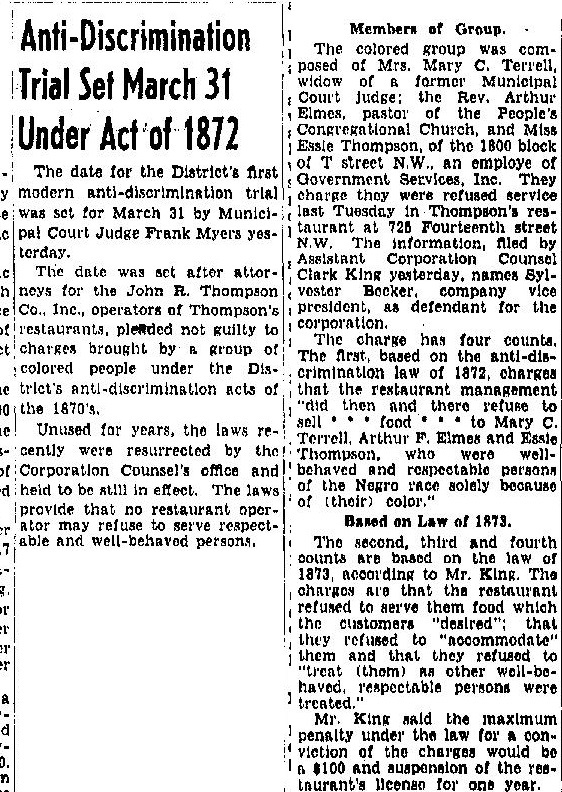
Article announcing the trial set that would test 1872 anti-discrimination laws in the Thompson's sit-in case
Source: Re-printed with permission from the D.C. Public Library, Star Collection, Washington Post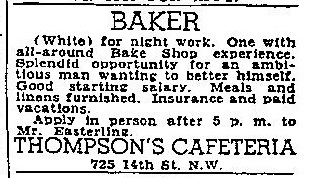
Thompson’s advertised for a baker (white) in 1951.
Source: Reprinted with permission of the DC Public Library, Star Collection, Washington Post